How to File an RTI Application Online in 2026 — A Step-by-Step Guide
Where is my passport application stuck? How much did the municipality spend on this road? What is the status of my pension file? Under the Right to Information Act, 2005, every public authority must answer questions like these — for a fee of ₹10, within 30 days, with penalties on the officer for stonewalling.
Twenty years on, RTI remains the sharpest everyday accountability tool an Indian citizen has. Here's how to use it well in 2026.
What you can ask, and whom
Any Indian citizen can seek information held by a public authority — central and state ministries, municipal bodies, police, government schools and hospitals, PSUs, and bodies substantially financed by government. You can ask for records, file notings, inspection reports, muster rolls, tender documents, or the status of your own application sitting in a government office.
Some information is exempt under Section 8 — national security, cabinet papers, trade secrets, ongoing investigations, and personal information (an exemption recently widened — more on that below). But the default under the Act is disclosure, not secrecy.
Filing online: step by step
For central government bodies, use rtionline.gov.in. Most states run their own portals for state departments (search "
- Register / submit a request on the portal with your name and contact details.
Before the request form itself, the portal shows a short verification screen. This is what it looks like, and what each field actually wants:
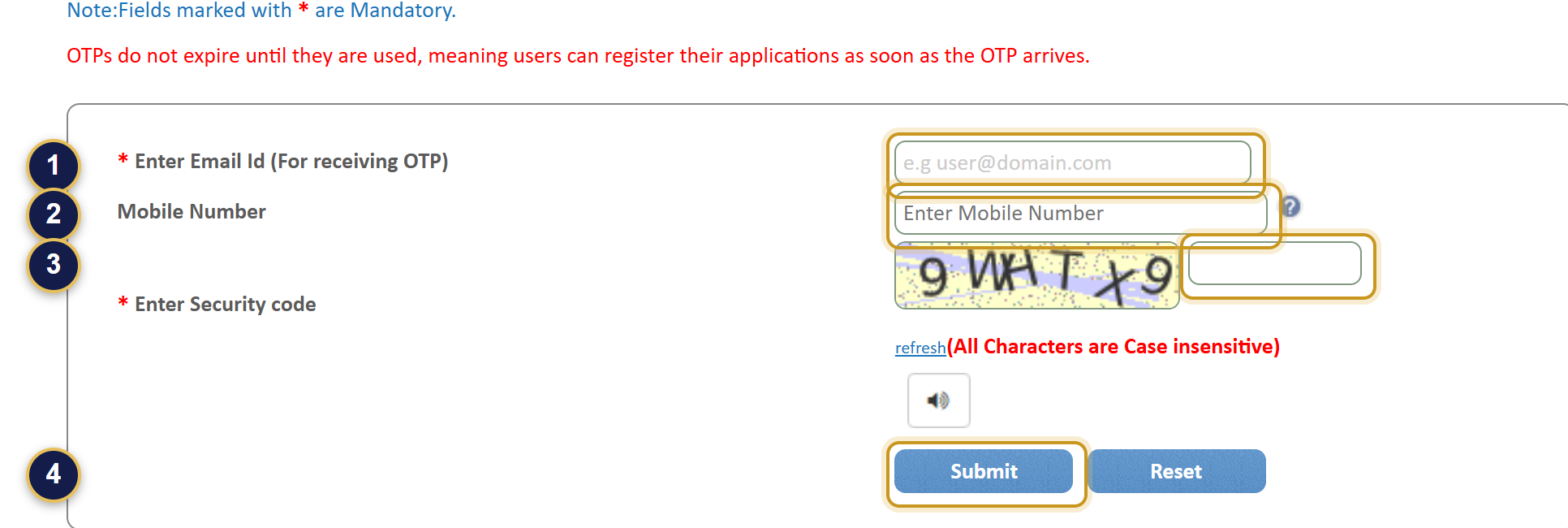
- Email ID — mandatory, and this is the address the OTP goes to. It is also where the department's reply will land, so use an address you actually check, not a throwaway.
- Mobile Number — note the missing red asterisk: this one is optional. Adding it is still worth doing, because SMS alerts about your application go here.
- Security code — the captcha. It is case-insensitive, and there's a
refreshlink plus an audio button if the characters are unreadable. - Submit — this only sends the OTP. Nothing is filed and no fee is charged at this stage; the actual request form comes after you enter the code.
A small detail the portal states on this screen and almost nobody notices: the OTP does not expire until it is used. If it takes ten minutes to arrive, it still works.
- Select the Ministry/Department. Don't agonise over precision — Section 6(3) obliges a wrongly-addressed PIO to transfer your application to the right authority within 5 days.
- Write your request (up to 3,000 characters online). Number your questions.
- Pay ₹10 online (UPI/card/net-banking). Applicants below the poverty line pay nothing — upload the BPL certificate.
- Save the registration number. You'll track status and file appeals with it.
The 30-day clock starts on receipt. If your query concerns the life or liberty of a person, the law requires a response within 48 hours.
Wording that gets answers
The difference between a useful reply and a runaround is usually the drafting.
| Weak wording | Strong wording |
|---|---|
| "Why is my pension not sanctioned?" | "Provide the current status and copies of file notings on my pension application no. XXX dated DD-MM-YYYY." |
| "Give all information about the road project." | "Provide the sanctioned amount, contractor name, completion deadline and latest inspection report for work order no. XXX." |
| "Is corruption happening in this office?" | "Provide the number of complaints received against officials of this office in 2024-25 and 2025-26, and action taken on each." |
Three rules: ask for records, not reasons (PIOs supply information, not justifications); be specific about period, office and document; and keep each application to one subject.
Request "certified copies" of key documents. Certified RTI replies are admissible evidence in consumer forums, courts and departmental proceedings — one RTI can quietly win a later case.
No reply? Appeal — it's free and it works
- First Appeal — to the First Appellate Authority (senior to the PIO, in the same department) within 30 days of the reply or the deadline lapsing. On rtionline.gov.in, click "Submit First Appeal" and cite your registration number. No fee.
- Second Appeal — to the Central Information Commission (cic.gov.in) or your State Information Commission within 90 days of the first-appeal outcome.
- The Commission can order disclosure and impose a penalty of ₹250 per day (up to ₹25,000) personally on a PIO for unjustified delay or refusal — the reason a well-drafted appeal often shakes information loose fast.
What changed recently — the DPDP amendment
The Digital Personal Data Protection Act amended RTI's Section 8(1)(j), broadening the exemption for "personal information" — making it harder to obtain, say, officials' asset declarations or named beneficiary lists. The amendment is contentious: petitions challenging the DPDP framework are before the Supreme Court, which issued notice in February 2026. Practical takeaway: frame requests around official records and actions, not individuals — "copies of inspection reports for X" survives scrutiny; "details about officer Y" invites the exemption. We cover this fully in our companion guide on RTI after the DPDP Act.
Common mistakes that get an RTI rejected
Most failed applications fail for avoidable reasons, not because the information was genuinely exempt.
- Asking questions instead of requesting records. "Why was my file delayed?" invites a non-answer. "Provide file notings and movement register entries for file no. XXX" does not.
- Bundling unrelated subjects. One application, one subject. Multiple subjects give a PIO grounds to reject or split the request and reset the clock.
- Being vague about scope. Always fix the period, office and document type. "All correspondence" over an unbounded period is the easiest kind of request to refuse as disproportionate.
- Seeking opinions or predictions. The Act covers information that exists on record — not what an officer thinks, or what will happen next.
- Naming individuals unnecessarily. Since the Section 8(1)(j) amendment, framing a request around a named person rather than an official action makes the personal-information exemption much easier to invoke.
- Missing the appeal window. The 30-day first-appeal deadline is where most people quietly lose. Diarise it the day you file.
Frequently asked questions
Who can file an RTI application?
Any citizen of India. There is no requirement to be affected by the matter, to state a reason for wanting the information, or to hold any particular status — and a PIO is not entitled to ask why you want it. The only common gate is citizenship.
What does it cost?
₹10 for the application itself. Applicants below the poverty line pay nothing on submitting a BPL certificate. You may later be asked for copying charges if the reply runs to many pages — but if the authority misses the 30-day deadline, the information is to be supplied free of charge.
How long does a reply take?
30 days from receipt. Where the request concerns the life or liberty of a person, the deadline is 48 hours. If your application is transferred to the correct authority under Section 6(3), the clock effectively runs from when that authority receives it.
What if I get no reply at all?
Silence is treated as a refusal, and it is appealable exactly like one. File a First Appeal to the First Appellate Authority within 30 days of the deadline lapsing — it is free, it is filed on the same portal with your registration number, and in practice it is what shakes most stalled applications loose.
Can I file an RTI against a private company or a bank?
Not directly. The Act covers public authorities and bodies substantially financed by government. You can, however, often get the information indirectly by asking the regulator or ministry that oversees the private body — records the regulator holds about a company are within reach even when the company itself is not.
Can I file an RTI from outside India?
The right is given to citizens, so Indian citizens abroad can use it, though online payment and the need for an Indian correspondence address can complicate matters in practice. Filing through a relative in India, or using the state portal for the relevant department, is usually simpler.
Will the department know who I am?
Yes — you file under your own name, and the PIO sees it. The Act does not provide for anonymous applications. If the subject is sensitive, keep your wording strictly about records and official actions, which is both harder to refuse and less likely to invite friction.
The bottom line
RTI turns "please sir, kindly do the needful" into a legal demand with a deadline. File online in ten minutes, word your questions around specific records, and appeal without hesitation — the appeal system is where RTI's real teeth are. ₹10 and a well-drafted question remain the cheapest legal power an Indian citizen can buy.
How this guide is made
Written and fact-checked by the Awareness360 editorial team from primary sources — RBI, SEBI, IRDAI, the Income Tax Department and Government of India portals — with links to the originals in the text above. Last reviewed on 12 Aug 2026. This is general educational information for Indian readers, not professional financial, legal or tax advice.
Spotted something out of date? Tell us and we'll correct it — see our editorial policy.