How to Report Cyber Fraud in India — 1930, cybercrime.gov.in, and What Happens Next
When an online scam takes your money, two clocks start at once: the scammer's, racing to move the money through layers of "mule" accounts and cash it out, and yours, to report fast enough that a bank can freeze it. Reporting quickly and correctly is what turns a loss into a recovery. Here's exactly how to do it — and what happens after you file.
The golden hour: dial 1930 first
The 1930 helpline is the National Cyber Crime Helpline, connected to the system that lets banks freeze fraud money in transit. It's the fastest tool you have, and it exists for this exact moment.
Call 1930 immediately and keep ready:
- Your bank account / UPI ID that was debited
- The transaction IDs, amounts and times (from your bank/UPI app history)
- The fraudster's number, UPI ID or account number, if you have it
- A one-line account of what happened
The operator logs your complaint into the reporting system, which alerts the banks in the money trail so they can place a lien (freeze) on the amount wherever it currently sits.
Don't call the scammer back, don't wait to "confirm" with relatives first. The faster you reach 1930, the higher the chance the money is still freezable. Save 1930 in your phone today, and tell your family the sequence.
Step 2: File on the National Cyber Crime Portal
Go to cybercrime.gov.in. The home page opens with three report categories, and picking the right one decides how your complaint is routed:
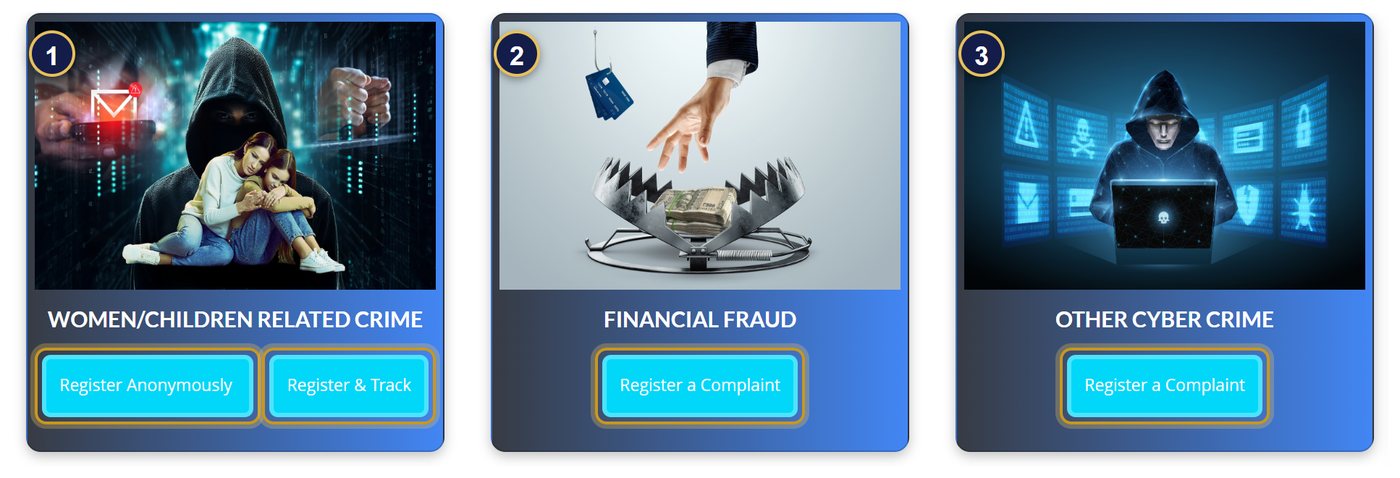
- Women/Children Related Crime — the only category offering Register Anonymously, so a victim can report without identifying themselves. The trade-off is real: an anonymous report cannot be tracked afterwards. Register & Track requires an account but lets you follow the case.
- Financial Fraud — this is the one to use if money has left your account: UPI fraud, card fraud, fake investment apps, loan-app extortion. It feeds the same system as the 1930 helpline, which is what makes a freeze on the receiving account possible.
- Other Cyber Crime — hacking, data theft, impersonation, harassment and everything not involving money.
If you are unsure between 2 and 3, ask a single question: did money move? If yes, use Financial Fraud, because that path triggers the banking-side workflow. A financial fraud filed under "Other" loses the very thing that makes speed matter.
- Register/log in, describe the incident, and upload evidence: transaction screenshots, chats, call logs, any links or numbers.
- Note the acknowledgement number — you'll need it for the bank and for any follow-up.
The 1930 call and the portal complaint feed the same system; doing both makes your case complete and traceable.
Step 3: Inform your bank
Call your bank's fraud helpline (on the back of your debit card), report the fraud, quote your acknowledgement number, and ask them to freeze UPI/cards if needed.
For unauthorised transactions (money taken without your involvement), RBI's customer-protection rules can give you zero liability if you report within 3 working days — so speed protects your rights as well as your money. If you were tricked into authorising the payment yourself, recovery depends more on how fast the money was frozen, which is why 1930 in the first hour is everything.
Step 4: The FIR and Zero FIR
For a serious or higher-value fraud, you may need a formal First Information Report (FIR). Under the new BNSS law:
- You can file at any police station — if it's outside that station's jurisdiction, they must register a Zero FIR and transfer it, not turn you away.
- You can also file an e-FIR online through your state police portal (sign it within the required window to complete it).
- In many places the cybercrime.gov.in complaint is itself converted into an FIR by the cyber cell; ask your local cyber police station.
We cover the full process in our guide to filing an FIR under the BNSS.
What happens after you report
A freeze is not yet a refund. Here's the typical path:
- The complaint alerts the banks holding the fraud money; eligible amounts are lien-marked (frozen).
- Your case is assigned to the relevant cyber cell / police station; respond promptly when they contact you.
- Refunds of frozen money usually happen through an order — often via the local cyber police or a magistrate's direction to the bank to reverse the frozen amount.
- Keep following up on the portal with your acknowledgement number. Recovery can take weeks to months — but frozen money is very often returned.
What to gather before you report
You will be asked for the same handful of details at every stage — 1930, the portal, your bank, the police. Collecting them once, up front, saves you repeating the scramble under pressure.
- Transaction proof — screenshots from your bank or UPI app showing the amount, date, time and transaction/UTR reference for every debit.
- The counterparty — the UPI ID, account number, phone number, website or app the money went to.
- The approach — screenshots of the SMS, WhatsApp chat, email or call log that started it, plus any links you were sent.
- Your own identifiers — the account or card that was debited, and the mobile number registered to it.
- A short timeline — what happened, in order, with times. Two or three sentences is enough.
Save all of it in one folder on your phone before you start filing. Do not delete the scammer's messages, however much you want to — they are your evidence.
If a police station turns you away
It still happens, and it is not something you have to accept. A station cannot refuse you on the grounds that the fraud "happened online" or "belongs to another district" — that is exactly what a Zero FIR exists for. If you are refused:
- Ask for the refusal in writing, or note the officer's name and the time. That request alone often resolves it.
- Escalate in writing to the Superintendent of Police for the district, who can direct that the complaint be registered.
- Keep your cybercrime.gov.in acknowledgement number visible throughout — a filed portal complaint is documentary proof that you reported, and it runs in parallel regardless of what the station does.
Watch out for the "recovery" second scam
After you've lost money, you may be contacted by a "recovery agent", "cyber cell" or "refund officer" promising to get it back for a fee. This is the same fraud network monetising its victim list. No genuine agency charges an upfront fee to recover fraud money. Deal only through 1930 and cybercrime.gov.in.
Quick reference
| You need to | Use |
|---|---|
| Freeze money fast | Call 1930 |
| File the written complaint | cybercrime.gov.in |
| Protect your bank liability | Your bank's fraud helpline, within 3 working days |
| Formal police record | FIR / Zero FIR / e-FIR |
| Report a scam number | Chakshu on sancharsaathi.gov.in |
Frequently asked questions
How long does it take to get frozen money back?
There is no fixed timeline. A freeze can happen within hours of your 1930 call, but the return of that money moves at the speed of the investigation and the order that releases it — commonly weeks, and sometimes several months. The single biggest factor is how quickly you reported, because that determines whether the money was still sitting in an account when the alert reached the bank.
Is it too late to report a fraud from weeks or months ago?
No — report it anyway. The chance of freezing the money drops sharply once it has been withdrawn, but a complaint still matters: it creates the official record you need for your bank, it can connect your case to a wider network the police are already tracking, and some recoveries do come long after the event. Late is worth far more than never.
Can I track my complaint after filing?
Yes. Keep the acknowledgement number issued when you file on cybercrime.gov.in — the portal lets you check the status of your complaint using it along with your registered mobile number. Quote the same number in every conversation with your bank and the police so all the records stay linked to one case.
Do I need a lawyer to report cyber fraud?
Not to report. The 1930 helpline, the portal complaint and an FIR are all things you can do yourself at no cost, and none of them require legal representation. A lawyer becomes useful later — if your case goes to court, if you are pursuing a bank over liability, or if you need help escalating a complaint that has stalled.
What if I approved the payment myself?
This matters more than people expect. RBI's customer-protection rules can give you zero liability for unauthorised transactions reported within 3 working days — money taken without your involvement. If you were tricked into authorising the transfer yourself, that protection generally does not apply, and your recovery depends almost entirely on whether the money was frozen before it was cashed out. It is the reason the 1930 call comes before everything else.
Does a small loss still deserve a report?
Yes. There is no minimum. Small frauds are how large networks operate at scale, and your complaint may be one of hundreds against the same account — which is often exactly what allows the police to act on it.
Someone is asking for a fee to recover my money. Is that real?
No. Treat it as a second fraud, aimed at people already known to be victims. No genuine agency charges an upfront fee to recover fraud money. Report only through 1930 and cybercrime.gov.in, and report the "recovery agent" too.
The bottom line
You can't always stop a scammer from targeting you, but you fully control what happens next: 1930 → cybercrime.gov.in → your bank → FIR if needed, as fast as you can, with every screenshot saved. That sequence is what freezes the money and starts it on the way back. Learn it, save the numbers, and share them with the people at home — because the person who knows the steps acts in minutes, and minutes are what recovery is made of.
How this guide is made
Written and fact-checked by the Awareness360 editorial team from primary sources — RBI, SEBI, IRDAI, the Income Tax Department and Government of India portals — with links to the originals in the text above. Last reviewed on 12 Aug 2026. This is general educational information for Indian readers, not professional financial, legal or tax advice.
Spotted something out of date? Tell us and we'll correct it — see our editorial policy.