How to Get Your Security Deposit Back — A Renter's Playbook
You move out, hand over the keys, and then the deductions begin — "painting charges", "deep cleaning", "wear and tear", a tap that was already loose. For millions of Indian renters, the security deposit is the hardest part of renting to get back. It doesn't have to be. With the right paperwork going in, and the right steps coming out, the deposit is yours.
Know the deposit cap
Under the Model Tenancy Act (MTA) framework — circulated to the states by the Ministry of Housing and Urban Affairs and now adopted or being adopted by a growing number of them — the residential security deposit is capped at two months' rent (six months for commercial). If you're in an MTA-aligned state, a landlord demanding six or eleven months upfront is asking for more than the law allows.
The deposit must be returned when you hand back possession, after deducting only lawful dues — genuinely unpaid rent or utility bills, or the cost of damage beyond normal wear and tear. It is not a fund for routine repainting or the landlord's regular maintenance.
The MTA applies only in states that have adopted it; others still follow older rent-control laws. Search "
Win the dispute before it starts — at move-in
Most deposit fights are really evidence fights. Set yourself up to win on day one:
- Get a written, signed agreement that states the deposit amount, the rent, the notice period, and exactly what can be deducted. In MTA states, register it with the Rent Authority.
- Photograph and video the whole home at move-in — walls, fittings, appliances, bathrooms — with a visible date. Share the file with the landlord and keep a copy.
- Make a signed condition/inventory list of the property's state and any existing damage, signed by both sides.
- Pay rent and deposit by bank transfer, never untraceable cash — so there's proof of what you paid.
Do these four things and "the wall was damaged" or "you never paid the deposit" simply can't stand.
When you're moving out
- Give proper written notice as per the agreement (commonly one month) — by email or message, so there's a record.
- Clean the place and fix anything you actually broke. Normal wear (faded paint, minor scuffs) is the landlord's cost, not yours.
- Do a joint final inspection with the landlord and compare against your move-in photos. Agree the deductions, if any, in writing.
- Ask for the refund in writing, with a clear date. Get any agreed deductions itemised.
If the landlord still won't return it
Escalate calmly and on paper:
- Send a written demand (email/message, or a formal letter) stating the amount owed, referencing your agreement and move-in evidence, and giving a reasonable deadline (say, 15 days).
- Go to the Rent Authority / Rent Court in MTA-aligned states — these forums exist specifically for landlord–tenant disputes and are meant to resolve them quickly. In other states, deposit recovery goes through the civil court or, where the relationship qualifies as a service, the consumer forum — which you can approach through the National Consumer Helpline or file online at e-jagriti.gov.in, the consumer e-filing platform.
- A legal notice from an advocate is often enough on its own — many landlords settle rather than face a formal proceeding.
- Keep every document: agreement, bank transfer records, move-in photos, the written demand, and all messages.
Unregistered 11-month agreements are common to dodge registration, but they don't suspend your rights — the deposit must still be returned, and you can still pursue recovery. Weak paperwork weakens your proof, not your entitlement. Which is exactly why the move-in photos and bank-transfer trail matter so much.
What landlords can legitimately deduct
To be fair to both sides — a landlord can lawfully deduct for:
- Unpaid rent or unpaid utility bills you owe
- Damage beyond normal wear and tear (a cracked basin, a burnt countertop — not faded paint)
- Anything specifically agreed in your signed contract
They generally cannot deduct for routine repainting, standard cleaning, or the natural ageing of fittings, unless your agreement clearly says so.
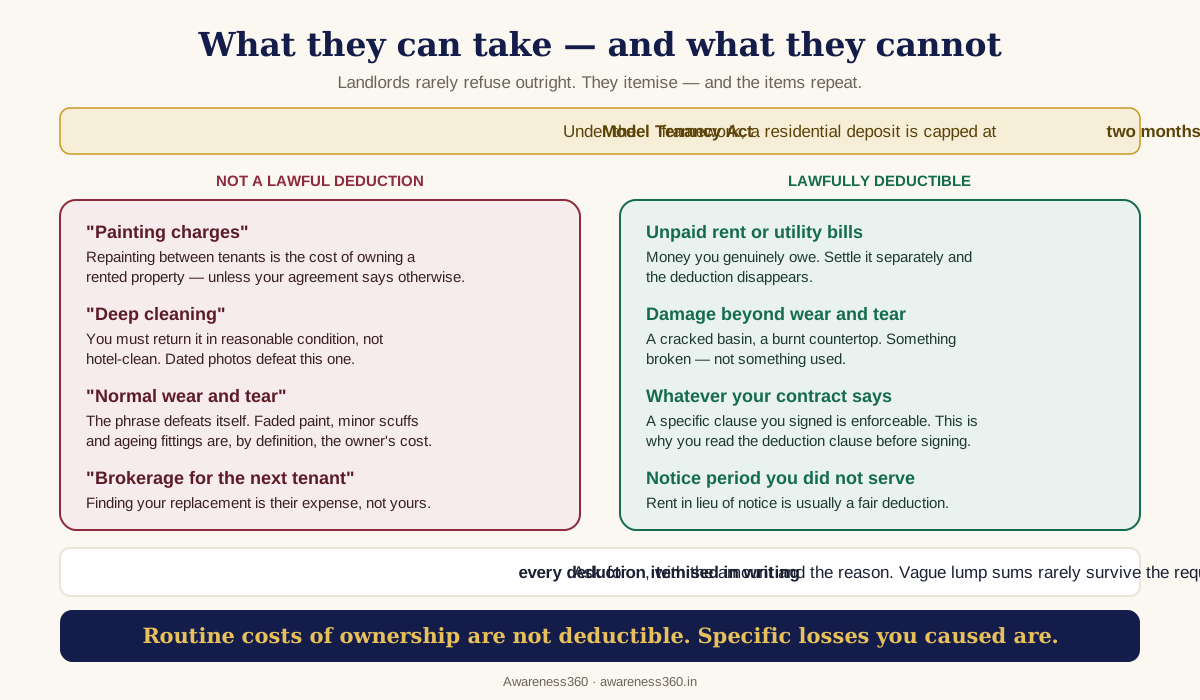
One test resolves almost every dispute on that page: would this cost have arisen anyway, with any tenant, at the end of any tenancy?
- If yes, it is a cost of owning a rented property — repainting between tenants, standard cleaning, fittings that aged, finding your replacement.
- If no, and it happened because of something you did, it is a lawful deduction. Arguing about those usually weakens your position on everything else.
- Anything your signed agreement specifically provides for sits outside the test entirely — which is why the deduction clause deserves a careful read before you sign, not after you move out.
How to answer the five most common deductions
Landlords rarely refuse outright. They itemise — and the items repeat. Here is what each one is actually worth arguing.
| What they claim | Where you stand |
|---|---|
| "Painting charges" | Repainting between tenants is routine maintenance and the cost of owning a rented property. Unless your agreement expressly makes you liable, or you painted the walls a colour you agreed to restore, this is not a lawful deduction. |
| "Deep cleaning" | You must return the home in reasonable condition, not hotel-clean. If you cleaned it and have dated photos, a professional-cleaning bill charged to you is contestable. |
| "Normal wear and tear" | This phrase defeats itself. Wear and tear is by definition the landlord's cost — faded paint, minor scuffs, ageing fittings, loosened hinges. Damage means something broken, not something used. |
| "Brokerage / commission" | The landlord's cost of finding the next tenant is not yours, and is not a lawful deduction from your deposit unless your agreement says so in terms. |
| "Notice period shortfall" | This one is often legitimate. If you left early without serving the agreed notice, rent in lieu of notice is a real deduction. Check what your agreement actually requires before disputing it. |
The pattern: routine costs of ownership are not deductible; specific losses you caused are. Ask for every deduction to be itemised in writing with the amount and the reason. Vague lump sums rarely survive that request, and many landlords quietly drop them at this stage.
Frequently asked questions
How long does a landlord have to return the deposit?
The deposit is due when you hand back possession, less any lawful dues. Agreements often specify a window — commonly 15 to 30 days — and where your state has adopted the Model Tenancy Act framework, the Rent Authority route exists precisely to enforce prompt return. If your agreement is silent, "on handing over possession" is the default position, and delay beyond a reasonable period is what your written demand should call out.
My agreement was never registered. Can I still recover my deposit?
Yes. An unregistered or 11-month agreement weakens your evidence, not your entitlement — the money is still yours. This is exactly why the move-in photographs, the signed inventory and a bank-transfer trail matter so much: they let you prove what you paid and what condition the property was in without relying on the agreement's registration status.
The landlord is deducting for damage I did not cause. What now?
Compare against your dated move-in photographs and the signed inventory, and put the comparison in writing. Ask for the deduction to be itemised with a repair estimate or bill. A landlord who cannot produce evidence of a cost, against a tenant who can produce evidence of prior condition, is in a weak position at any forum.
Can I just refuse to pay the last month's rent instead?
Tempting, and usually a mistake. Withholding rent converts you from the wronged party into one who has admittedly defaulted — and gives the landlord a clean, lawful deduction that consumes exactly the money you were trying to protect. Pay the rent, hand over possession, and pursue the deposit as a separate claim on your own evidence.
Where do I actually file if they refuse?
It depends on your state. In states that have adopted the Model Tenancy Act framework, the Rent Authority or Rent Court is the designated forum for landlord–tenant disputes and is designed for speed. Elsewhere, recovery generally runs through the civil court, and in some circumstances the consumer route. Search "your state rent authority" to find your position before drafting anything.
Is a lawyer's notice worth the cost?
Often, yes — disproportionately so. A formal legal notice signals that you intend to pursue the matter and costs far less than litigation. In practice a large share of deposit disputes settle at exactly this point, because the landlord's calculation was always that you would give up rather than escalate.
The landlord sold the property. Who owes me the deposit?
Raise it with both. Your claim arises from your agreement, and the obligation does not simply evaporate on sale — arrangements between the old and new owner are their concern, not a reason for you to lose your money. Put your demand in writing to the person you paid, and to the new owner if they have taken over as landlord.
The bottom line
Your security deposit is your money, held in trust — not a bonus for the landlord. Protect it at move-in with a registered agreement, dated photos, a signed inventory and bank-paid transactions. At move-out, give notice, do a joint inspection, and demand the refund in writing. If they stall, the Rent Authority, a legal notice or the consumer/civil route will back you — and with your evidence in hand, they usually settle before it gets that far.
How this guide is made
Written and fact-checked by the Awareness360 editorial team from primary sources — RBI, SEBI, IRDAI, the Income Tax Department and Government of India portals — with links to the originals in the text above. Last reviewed on 12 Aug 2026. This is general educational information for Indian readers, not professional financial, legal or tax advice.
Spotted something out of date? Tell us and we'll correct it — see our editorial policy.