Forgotten Bank Money? How to Find and Claim It with RBI's UDGAM Portal
Somewhere in India's banking system sits a staggering pile of money that nobody has claimed — old savings accounts gone dormant, fixed deposits that matured and were forgotten, accounts of relatives who passed away without the family knowing they existed. When a deposit stays inactive for 10 years, banks transfer it to the RBI's Depositor Education and Awareness (DEAF) Fund — and the total runs into tens of thousands of crores of rupees.
The good news: it's still your money, and there's now a single free portal to find it.
What counts as an "unclaimed" deposit
A deposit becomes unclaimed when there's been no customer-initiated activity for 10 years. This commonly happens with:
- Savings/current accounts you stopped using after changing jobs or cities
- Fixed deposits that matured but were never withdrawn or renewed
- Accounts of a deceased family member whose heirs didn't know about them
- Old accounts from before KYC linking, with outdated contact details
Importantly, moving to the DEAF Fund does not extinguish your claim. You (or your legal heirs) can always reclaim the amount — with the interest due — by approaching the bank.
Step 1: Search with UDGAM
The RBI's UDGAM portal (Unclaimed Deposits – Gateway to Access Information) lets you search for unclaimed deposits across multiple banks in one place, for free.
- Go to udgam.rbi.org.in and register with your mobile number.
- Enter the account holder's name and select the bank(s).
- Optionally add identifiers (PAN, driving licence, date of birth) to narrow results.
- The portal shows matching unclaimed deposits held with participating banks.
UDGAM is one of the few easy ways for a family to discover accounts a deceased parent or grandparent never mentioned. Search their name across the banks they were likely to have used.
Step 2: Claim it from the bank
UDGAM helps you find the money; the actual claim is settled by the bank, not the RBI. Approach the branch (or its unclaimed-deposits desk) with:
- A filled claim form (available at the branch or the bank's website)
- Your KYC documents — identity and address proof
- Proof linking you to the account (old passbook, statement, or the account number)
- For a deceased holder's deposit: the death certificate, and either the nominee proof or legal-heir documents (succession certificate / legal heir certificate) if there's no nominee
The bank verifies and refunds the principal plus the interest payable up to the date of settlement.
Unclaimed money isn't only in bank accounts
UDGAM covers bank deposits. Several other pools of forgotten money sit in entirely separate systems, each with its own portal — and families searching for a late relative's assets routinely miss them.
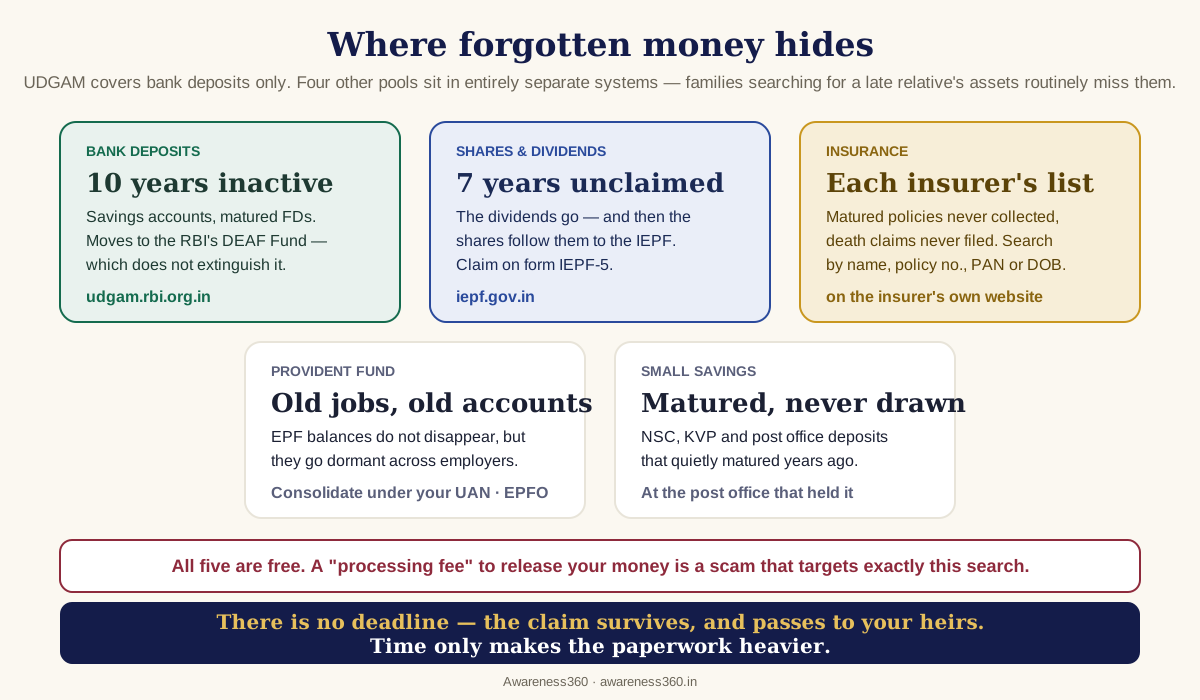
That map matters more than any single portal, because each pool has its own trigger, its own custodian and its own claim form — and none of them talks to the others.
- Searching UDGAM and finding nothing proves exactly one thing: that no participating bank holds an unclaimed deposit under the spelling you tried. It says nothing at all about shares, insurance, provident fund or post office savings.
- The seven-year IEPF trigger is the one that catches families out, because the shares themselves move, not just the dividends. A demat account that looks empty may simply have been emptied by that transfer.
- Do all five in a single pass, with one set of documents. The death certificate, your proof of relationship and the nominee or legal-heir papers are the same everywhere. Assembling them once and working down the list is what turns a vague suspicion into recovered money.
Shares and dividends — the IEPF. Where dividends stay unclaimed for seven consecutive years, the shares themselves are transferred along with the dividends to the Investor Education and Protection Fund. This catches out families constantly: the shareholding still exists, but it is no longer in the demat account. Search and claim at iepf.gov.in using the IEPF-5 form. The process runs through the company's nodal officer and takes longer than a bank claim, so start early.
Insurance policies. Insurers are required to publish unclaimed policyholder amounts — matured policies never collected, death claims never filed, refunds never encashed — on their own websites, searchable by name, policy number, PAN or date of birth. If you know or suspect which insurer a relative used, check there. Where you do not, IRDAI's grievance channels can help point you.
Provident fund. Old EPF accounts from previous jobs do not disappear, though they can become dormant and hard to trace across employers. Consolidate them under your UAN on the EPFO portal; for a deceased member, the nominee or legal heir claims through the employer or the EPFO office.
Small savings and post office. Matured NSC, KVP and post office deposits that were never withdrawn are claimed at the post office where the account was held.
Work through all five systematically — UDGAM for bank deposits, IEPF for shares and dividends, the insurers' unclaimed lists, EPFO for provident fund, and the post office for small savings. Take the death certificate, your proof of relationship, and the nominee or legal-heir documents to each. It is slow, and it is regularly worth far more than families expect.
Why nomination is the real fix
Most unclaimed money becomes a problem because the family didn't know the account existed and there was no nominee. A nominee is the person the bank can pay directly, without a court process. So:
- Add a nominee to every bank account, FD, and locker — it takes minutes at the branch or in net banking.
- Keep your mobile number and address updated so the bank can reach you before an account goes dormant.
- Do a small transaction once a year on old accounts to keep them active — or formally close ones you don't need.
- Keep a simple list of your accounts somewhere your family can find it.
Fraudsters exploit this topic — sending fake "claim your unclaimed money, pay a processing fee" links. UDGAM is free, the RBI never charges a fee, and no genuine claim requires you to pay upfront or share an OTP. Use only the official udgam.rbi.org.in address.
Frequently asked questions
Does my money still earn interest after it moves to the DEAF Fund?
Yes for interest-bearing accounts. Transfer to the fund is an administrative move, not a forfeiture — when you claim, the bank settles the principal along with the interest payable up to the date of settlement, and then recovers it from the RBI. You are not penalised for having lost track of it.
Is there a deadline to claim?
No. There is no time limit after which unclaimed deposits stop being yours — the claim survives indefinitely, and passes to your legal heirs. What time does affect is difficulty: older accounts mean outdated KYC, closed branches, merged banks and, where the holder has died, a heavier documentation burden. Claim sooner because it is easier, not because it expires.
The bank has merged with another bank. Who do I claim from?
The bank that acquired it. Deposit liabilities transfer with the merger, so the successor bank settles the claim. UDGAM reflects participating banks under their current identity — search under the present name, and if you are unsure which entity absorbed an old bank, the branch will be able to tell you.
What if there is no nominee and the holder has died?
You claim as a legal heir, which requires more paperwork — typically the death certificate plus a succession certificate, legal heir certificate, or the bank's indemnity-and-declaration route, depending on the amount and the bank's policy. Many banks settle smaller amounts on an indemnity without a court process, so ask what their threshold is before assuming you need a succession certificate.
Does searching UDGAM cost anything?
Nothing. The portal is free, registration is free, and the claim itself carries no fee at the bank. Anyone asking for a "processing fee", "release charge" or "tax" to unlock unclaimed money is running a scam that specifically targets people searching for this — and no genuine claim ever needs your OTP.
I found nothing on UDGAM. Does that mean there is nothing?
Not necessarily. Not every bank participates equally, name spellings vary across old records, and the portal only covers bank deposits — not shares, insurance, provident fund or post office savings. Try name variants and initials, then check the other systems above before concluding there is nothing to find.
How do I stop my own accounts from ending up here?
Four things, all quick. Add a nominee to every account, FD and locker. Keep your mobile number and address current with each bank. Put through a small transaction once a year on accounts you want to keep, and formally close the ones you do not. And leave your family a written list of where your accounts and policies are — that single page prevents most of what this article is about.
The bottom line
Dormant money doesn't disappear — it waits. Search your name (and your family's) on the RBI's free UDGAM portal, and claim anything you find directly from the bank with your KYC and proof of entitlement. Then close the loop for good: add a nominee to every account, keep your contact details current, and leave your family a list. The best unclaimed deposit is the one that never becomes unclaimed.
How this guide is made
Written and fact-checked by the Awareness360 editorial team from primary sources — RBI, SEBI, IRDAI, the Income Tax Department and Government of India portals — with links to the originals in the text above. Last reviewed on 12 Aug 2026. This is general educational information for Indian readers, not professional financial, legal or tax advice.
Spotted something out of date? Tell us and we'll correct it — see our editorial policy.