How to Start Your First SIP in 2026 — From ₹100 a Month
For decades, "start investing" felt like advice meant for people with money to spare. In 2026, that excuse is gone: almost every large fund house now offers a SIP starting at just ₹100 a month — the "Chhoti SIP" push encouraged by SEBI to bring first-time savers into mutual funds. And a full overhaul of the rules, the SEBI (Mutual Funds) Regulations, 2026, has made the whole system clearer and safer for beginners.
Here's how to start your first SIP sensibly.
What a SIP actually is
A Systematic Investment Plan (SIP) is simply an instruction to invest a fixed amount into a mutual fund automatically, at a fixed interval — usually monthly. You're not buying a product called "SIP"; you're buying a mutual fund, in small regular instalments, instead of one lump sum.
Two things make it powerful for beginners:
- Rupee-cost averaging — you buy more units when markets are low and fewer when high, smoothing out the price you pay over time.
- Discipline — the auto-debit means you invest before you get a chance to spend, every month.
A ₹500/month SIP for 20 years does far more than a ₹50,000 lump sum you keep postponing. With SIPs now starting at ₹100, the barrier to beginning is essentially zero. The habit compounds as much as the money.
What's new under SEBI's 2026 rules
The SEBI (Mutual Funds) Regulations, 2026 replaced a framework that had been in place since 1996. The regulations themselves are published by the Securities and Exchange Board of India, and SEBI's investor education portal explains them in plain terms. For an ordinary investor, the practical upgrades are:
- Standardised disclosures — fund categories, risks and fees must be presented in a consistent format across all fund houses, so you can actually compare apples to apples.
- Stronger KYC and nomination norms — see the nomination rule below.
- Clearer risk labelling — making it harder to be sold a riskier fund than you understood.
The nomination rule you must not ignore
From 1 September 2026, anyone opening a single-holder mutual fund folio or demat account must either nominate a beneficiary or formally opt out through a declaration. You can now add up to 3 nominees, and the old witness requirement has been removed. Nominating means your family can actually access your investments if something happens to you — do it when you start.
Starting your first SIP: step by step
- Complete your KYC. One-time, digital, via any fund house, a platform, or a KYC Registration Agency. You'll need PAN and Aadhaar.
- Pick the type of fund. For a first-timer with a long horizon, a broad index fund (tracking the Nifty 50 or Sensex) or a flexi-cap fund is a common, low-drama starting point. Avoid thematic or sector funds until you understand them.
- Decide the amount and date. Choose an amount you won't miss — even ₹100–₹500 to begin — and a date just after payday so the balance is there.
- Set up the auto-debit (e-mandate). You approve a mandate once; instalments then run automatically.
- Nominate, confirm, and you're investing.
How to choose a fund without overthinking
| Look at | What's sensible for a beginner |
|---|---|
| Category | Index fund or flexi-cap for a first SIP |
| Expense ratio | Lower is better; index funds are cheapest |
| Track record | Prefer a fund/AMC with a long, consistent history |
| Direct vs Regular plan | Direct plans have lower fees (no distributor commission) — more of your money stays invested |
| Your horizon | Equity SIPs are for 5+ years; for shorter goals, consider debt funds |
The biggest beginner mistake is picking last year's top-performing fund and expecting a repeat. Chasing returns usually means buying high. Pick a sensible category, keep costs low, and give it years — not months.
The one row in that table worth doing arithmetic on
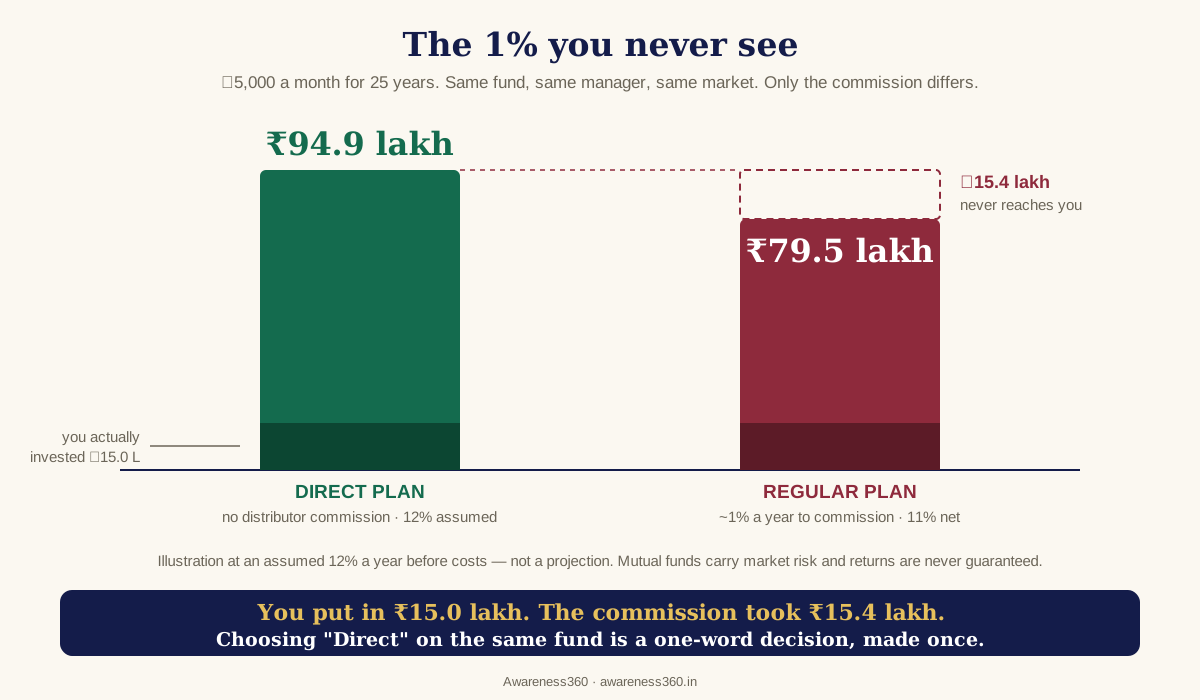
Same fund, same manager, same portfolio. The only difference is the distributor commission built into a regular plan's expense ratio — and it is deducted whether the fund does well or badly.
- The gap is not the commission; it is the commission plus everything it would have earned. About 1% a year sounds like a rounding error next to a 12% return. Over twenty-five years it compounds into more than the total you contributed.
- It is a one-word choice, made once. Every scheme exists in both versions, and you pick the direct one at the moment you set up the SIP. Nothing to monitor afterwards, nothing to switch.
- The assumed rate barely matters to the conclusion. Change 12% to anything between 8% and 15% and the final corpus changes enormously — but the share of it lost to a 1% drag stays between roughly 15% and 17%, because that proportion is a function of the cost and the years, not of the market.
The honest caveat: a regular plan buys you a distributor, and if that person genuinely stops you from panic-selling in a crash, they may earn it. Paying for advice you actually use is a decision. Paying for it by default because the app pre-selected "Regular" is not.
Staying the course
The real returns in SIPs come from not stopping when markets fall — that's exactly when your fixed instalment buys the most units. Markets will drop sometimes; that's normal and, for a long-term SIP, even helpful. Review once a year, increase your SIP amount as your income grows (a "step-up SIP"), and otherwise leave it alone.
What to do when the market falls
It will, and this is the only part of SIP investing that is genuinely hard. Everything else is paperwork.
Understand what is actually happening. Your instalment is fixed, so a lower price means it buys more units. A long fall early in your investing life is, arithmetically, good for you — you accumulate more units cheaply and they are worth more when markets recover. It does not feel that way, which is precisely why most people get it wrong.
The three mistakes, in order of cost:
- Stopping the SIP. This converts a paper fall into a permanent one: you stop buying at exactly the cheapest prices and typically restart only after the recovery has happened. It is the single most expensive habit in retail investing.
- Redeeming in panic. A fall is not a loss until you sell. Selling makes it real and removes you from the recovery.
- Switching funds because yours fell. In a broad market fall, nearly everything falls. Moving to whichever fund fell least is chasing performance and usually means selling low to buy high — with a tax event attached.
What to do instead: nothing, deliberately. If you want an active response, the useful one is to increase the instalment when prices are lower, not reduce it. And if a fall is causing you genuine distress, the real signal is that too much of your money is in equity for your time horizon — fix the allocation once, calmly, rather than reacting to each move.
The instalment must be small enough that you never need to cancel it in a difficult month. A ₹500 SIP you maintain for fifteen years beats a ₹5,000 SIP you abandon in year two — by a wide margin.
Step up as your income grows
The step-up (or top-up) SIP is the most under-used feature in retail investing and it is available on most platforms as a checkbox at setup.
You instruct the platform to raise your instalment automatically each year — by a fixed percentage or amount. Because the increase tracks your salary rises, it never feels like a cut in spending, and it compounds against the largest gap in most people's plans: starting small and never revisiting it.
If you set nothing else this year, set an annual step-up on your existing SIP. It is a single toggle, and over a working life it usually matters more than which fund you picked.
A quick note on risk and advice
Mutual funds carry market risk — your investment can go down as well as up, and returns are never guaranteed. This guide is educational, not personalised advice. For choices tied to your specific goals and risk appetite, consider a SEBI-registered investment adviser — you can verify any adviser's registration against SEBI's public list at sebi.gov.in. Scheme-level data for every fund house is published by AMFI.
Frequently asked questions
How much do I need to start a SIP?
As little as ₹100 a month with many fund houses now, following SEBI's push to bring first-time savers in. The amount matters far less than the start date and the number of years — the habit is what compounds. Begin with something you will not notice leaving your account, then step it up as your income grows.
Can I stop or pause my SIP anytime?
Yes, without penalty. A SIP is an instruction, not a contract with a lock-in — the exception is ELSS, where each instalment is locked for three years for tax purposes. Most platforms also offer a pause for a few months, which is the better option in a temporary cash crunch. What you should avoid is stopping because markets fell.
Is a SIP safe? Can I lose money?
A SIP is a method, not a guarantee — the risk comes from the underlying fund. Equity funds can and do fall, sometimes sharply, and there is no assured return. What a SIP does is spread your entry price over time and remove the need to time the market. For money you will need within a year or two, equity is the wrong place regardless of how you invest it.
SIP or lump sum — which is better?
If you already hold the money and your horizon is long, investing it tends to beat drip-feeding, simply because markets rise more often than they fall. The honest caveat is behavioural: a lump sum invested just before a fall is very hard to sit through. A SIP is easier to keep doing, and the plan you actually stick with beats the theoretically optimal one you abandon.
How many SIPs should I have?
Fewer than you think. Two or three funds is ample for most people, and a single broad index fund is a perfectly respectable starting point. Ten SIPs across overlapping funds is not diversification — the funds hold largely the same companies — it is just harder to track and rebalance.
What happens if my bank balance is short on the SIP date?
The instalment bounces. The fund house simply does not receive it, your bank may levy a mandate-failure charge, and repeated failures can cause the SIP to be cancelled. Nothing catastrophic happens, but set the date shortly after payday to avoid it, and keep the amount modest enough that a bad month does not break it.
Do I need to nominate a beneficiary?
Yes — and from 1 September 2026, anyone opening a single-holder folio or demat account must either nominate or formally opt out through a declaration. You can add up to three nominees, and the witness requirement has been removed. Do it at setup: without it, your family may face a lengthy legal process to access money that was always meant for them.
Direct or regular plan?
Direct, for almost everyone starting out. Same fund, same manager, same portfolio — but no distributor commission built into the expense ratio. That difference is roughly 0.5%–1% a year, which compounds into a very large number over two or three decades. See our mutual funds primer for the arithmetic.
The bottom line
There has never been a lower barrier to starting: ₹100 a month, standardised disclosures you can compare, and clearer rules protecting you. Complete your KYC, pick a low-cost broad fund, set an auto-debit you won't miss, nominate a beneficiary, and let time do the heavy lifting. The best SIP is the boring one you started years ago and never stopped.
Start investing in mutual funds
Open a free account and begin a SIP with as little as ₹100.
Open Free AccountHow this guide is made
Written and fact-checked by the Awareness360 editorial team from primary sources — RBI, SEBI, IRDAI, the Income Tax Department and Government of India portals — with links to the originals in the text above. Last reviewed on 12 Aug 2026. This is general educational information for Indian readers, not professional financial, legal or tax advice.
Spotted something out of date? Tell us and we'll correct it — see our editorial policy.