Health Insurance in 2026 — Your New Rights Under IRDAI's Rules
A hospital bill is the fastest way for an Indian family to fall into debt — and for years, health insurance came with enough fine print that people weren't sure it would actually pay when needed. A wave of IRDAI (Insurance Regulatory and Development Authority of India) reforms has changed that, shifting the balance firmly toward the policyholder.
If you hold a health policy — or are about to buy one — here are the rights you now have.
1. Cashless treatment at any hospital
Under IRDAI's "Cashless Everywhere" framework, you can get cashless treatment at any hospital, not just those on your insurer's network list. Previously, walking into a non-network hospital meant paying the full bill yourself and claiming reimbursement later — a painful gap during an emergency. Now the cashless facility travels with you.
Cashless Everywhere works best when you notify your insurer/TPA — ideally 48 hours before a planned admission, or within 24 hours of an emergency. Keep your policy number and the insurer's helpline saved in your phone.
2. Claim approvals on the clock
Delays used to be the worst part of a hospital stay. IRDAI now sets hard timelines:
| Situation | Timeline |
|---|---|
| Cashless pre-authorisation (admission) | Within 1 hour of request |
| Final cashless approval (at discharge) | Within 3 hours of the hospital submitting discharge papers |
| Reimbursement claims | Settled within 30 to 45 days of the last document |
If the insurer causes a delay in settlement, it must pay you interest at 2% above the bank rate on the claim amount. The days of being stuck at the discharge desk for hours waiting on approval are meant to be over.
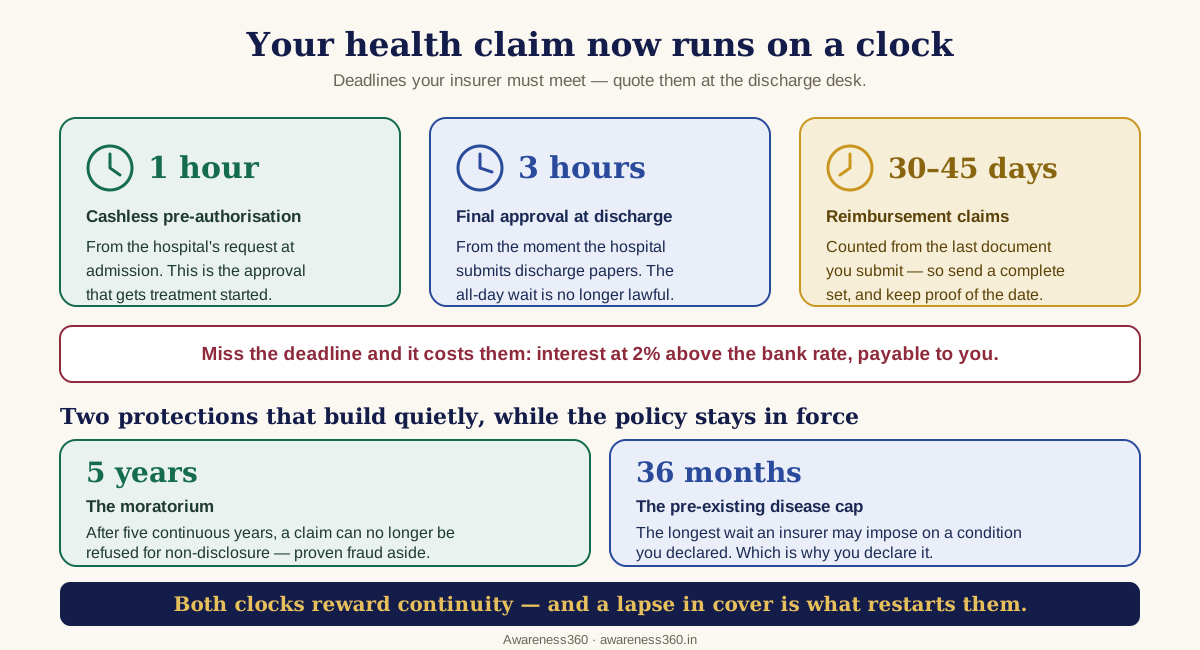
The practical value of those numbers is that they change what you can say at the desk:
- Quote the clock, in writing, from the hospital. "The pre-authorisation is due within an hour" said to the TPA desk, and repeated in a message to the insurer's helpline, turns a vague wait into a documented delay. That record is what makes the interest provision more than decoration.
- **The reimbursement clock starts from your last document, not your first.** An incomplete submission silently resets what you thought you were counting. Send a complete set, list what you sent, and keep the acknowledgement.
- The two protections at the bottom are earned, not bought. Neither the five-year moratorium nor the pre-existing-disease cap costs a rupee — they accrue purely because the policy stayed in force. Which is why a lapsed renewal is far more expensive than the premium you skipped.
3. No claims rejected after 5 years — the moratorium
This is one of the most powerful protections and few people know it. After five continuous years of coverage (the "moratorium period"), your insurer cannot reject a claim on the grounds of non-disclosure or misrepresentation — except in cases of proven fraud. Keep renewing the same policy without a break and you build this shield automatically.
4. No upper age limit to buy
IRDAI has removed the age cap on buying health insurance — insurers must offer policies to people of all ages, including senior citizens who were previously refused. Coverage is also renewable for life, regardless of your age or how many claims you've made.
5. Shorter waiting for pre-existing diseases
The maximum waiting period an insurer can impose for pre-existing diseases is capped at 36 months (3 years). After that, conditions you declared at the start must be covered. Always declare pre-existing conditions honestly when buying — non-disclosure is the single biggest reason genuine claims get disputed within the first five years.
6. Multiple claims for benefit policies
If you hold a benefit-based policy (one that pays a fixed sum on a defined event, like a critical-illness cover), you can now claim from multiple insurers for the same illness — useful when one policy alone won't cover the financial shock.
What to check before you buy
| Feature | Why it matters |
|---|---|
| Sum insured | ₹5–10 lakh is a sensible floor in metros; medical inflation is real |
| Room-rent capping | A capped room rent can proportionately cut your whole claim — prefer no sub-limit |
| Co-payment | A co-pay means you share every bill; understand it before buying |
| Restoration benefit | Refills your cover if you exhaust it mid-year |
| Network + Cashless Everywhere | Confirm the insurer's claim-settlement ratio and process |
A health policy's job is to protect your savings from a medical shock. The Section 80D tax deduction (old regime) is a bonus, not the reason to buy — and under the default new tax regime it isn't available at all. Choose the cover that fits your family, then claim the deduction if you're eligible.
If a claim is wrongly rejected
- Ask the insurer for the rejection in writing, with the specific policy clause cited.
- Escalate to the insurer's Grievance Redressal Officer, then to IRDAI's Bima Bharosa portal (bimabharosa.irdai.gov.in).
- For claims up to a threshold, approach the Insurance Ombudsman — it's free and doesn't need a lawyer.
- Keep every document: policy, bills, discharge summary, and all communication.
Frequently asked questions
What exactly is the moratorium, and why does it matter so much?
After a policy has been continuously in force for five years, an insurer can no longer reject a claim on the ground of non-disclosure or misrepresentation — established fraud aside. It is the health-insurance equivalent of a statute of limitations on the insurer's ability to reopen your application. Two consequences follow: buy early, because every year moves you closer to that protection, and never let the policy lapse, since a break can restart the clock.
Does declaring a pre-existing condition mean I will be refused?
Usually not. It typically means a waiting period for that condition, sometimes a loading on the premium, and occasionally a specific exclusion. What non-disclosure means is far worse: a claim rejected at exactly the moment you need it, after years of paying premiums. Declare everything — including conditions you consider minor, past hospitalisations and regular medication — and let the insurer price it.
Can my insurer refuse to renew the policy, or drop me after a big claim?
Health policies are lifelong renewable, and an insurer cannot decline renewal merely because you claimed or because you have aged. Premiums can rise at defined revision points, and they do rise with age bands, but that is different from being dropped. Renew on time; a break in cover is the one thing that genuinely puts your accrued benefits at risk.
The hospital says cashless isn't available. What do I do?
Cashless is now meant to be available across hospitals rather than only within a narrow network, and approvals run to defined timelines. If a hospital refuses, contact your insurer or TPA directly from the hospital and ask them to authorise. If cashless still cannot be arranged, pay and file for reimbursement — keep every original bill, the discharge summary, prescriptions and diagnostic reports. Reimbursement is slower, not weaker.
How much cover should I buy?
More than feels necessary, because the cost of being under-insured shows up only once. Judge it against what a serious hospitalisation actually costs in your city rather than against your premium budget, and remember that a modest sum insured today will look small in a decade of medical inflation. A larger base cover, or a top-up over a base policy, is generally better value than a small policy with add-ons.
Is my employer's group cover enough?
Treat it as a supplement. It ends when the job does — often precisely when you are least able to buy fresh cover — it rarely accounts for your family's full needs, and it accrues you no waiting-period credit of your own. Hold a personal policy alongside it, and start it early while you are healthy and can be underwritten easily.
My claim was rejected. What are my options?
Escalate in order, in writing. First the insurer's grievance officer, with the rejection letter and your policy documents. Then IRDAI's grievance mechanism. Then the Insurance Ombudsman, which is free, does not require a lawyer, and handles exactly these disputes. Keep every document, and note that where an insurer delays a valid claim beyond the prescribed timelines, interest is payable to you.
Can I switch insurers without losing my waiting periods?
Yes — through portability. Waiting periods already served and accrued continuity benefits carry over to the new insurer, so switching does not reset you to zero. Apply well before your renewal date rather than at the last minute, since the process takes time and a lapse in between would defeat the point.
The bottom line
Health insurance in 2026 is a genuinely stronger contract than it was a few years ago: cashless anywhere, approvals on a clock, lifelong renewability, no age bar, and a five-year moratorium that locks in your protection. Buy an adequate sum insured, declare your history honestly, renew without breaks — and know that if an insurer drags its feet, the rules, and the interest penalty, are now on your side.
Compare term & health insurance
Get quotes from top insurers in minutes.
Compare PlansHow this guide is made
Written and fact-checked by the Awareness360 editorial team from primary sources — RBI, SEBI, IRDAI, the Income Tax Department and Government of India portals — with links to the originals in the text above. Last reviewed on 12 Aug 2026. This is general educational information for Indian readers, not professional financial, legal or tax advice.
Spotted something out of date? Tell us and we'll correct it — see our editorial policy.