ITR Filing for AY 2026-27 — New Deadlines, New Forms, and What the New Tax Act Means
Filing season for Assessment Year 2026-27 (the income you earned in FY 2025-26) is underway — and it's a historic one. This is the last return you'll ever file under the Income Tax Act, 1961, the law that has governed Indian income tax for over six decades. Its replacement, the Income Tax Act, 2025, takes effect from 1 April 2026 and will govern next year's filing.
For this year, though, the framework is familiar — with a few important changes to deadlines and forms. Here's what a salaried employee, a gig worker or a first-time filer needs to know.
First: which law applies this year?
There's understandable confusion, so let's be clear:
- AY 2026-27 (filing now): covers income earned in FY 2025-26 — before the new Act began. Your entire return is governed by the old Income Tax Act, 1961. Nothing about the new law changes this year's filing.
- AY 2027-28 (filing next year): will cover FY 2026-27 income and will be the first return under the Income Tax Act, 2025.
So treat this as a normal filing year, with the updates below.
The deadlines have changed — check yours carefully
For the first time, your due date depends on which ITR form applies to you, and non-audit business/professional filers get an extra month over salaried filers.
| Who you are | ITR form | Due date (AY 2026-27) |
|---|---|---|
| Salaried / most individuals (no audit) | ITR-1 / ITR-2 | 31 July 2026 |
| Non-audit business & professionals | ITR-3 / ITR-4 | 31 August 2026 |
| Taxpayers requiring audit | ITR-3 etc. | 31 October 2026 (audit report by 30 Sep) |
The extra month for ITR-3/ITR-4 non-audit filers is written into the Finance Act, 2026 — so it repeats every year. The revised return window has also been extended to 31 March 2027, giving you far longer to fix a mistake than the old December cutoff.
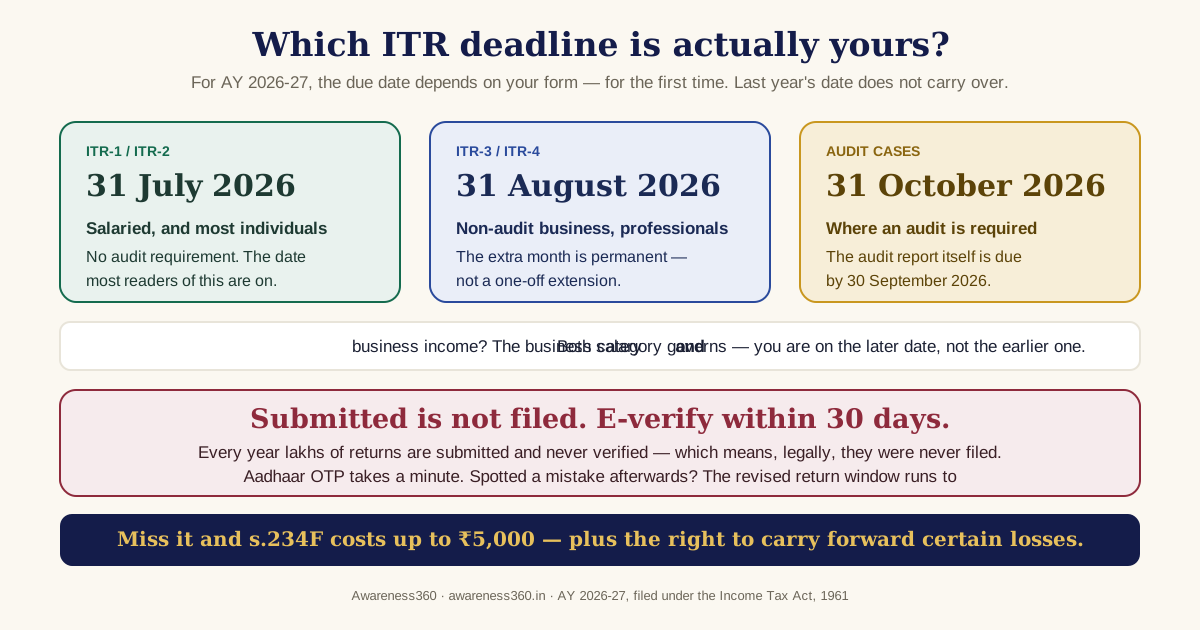
Two things in that picture account for most avoidable penalties:
- The deadline is now a property of your form, not of the calendar. People who filed by 31 July for years assume that is simply "the date" — while people with freelance or small-business income assume the same thing and rush a month early for no reason. Work out which form applies before you work out when to file.
- Submission and filing are different events. A return is not filed until it is verified, and the thirty-day window is where lakhs of returns quietly die each year. Do the Aadhaar OTP in the same sitting: the gap between "I submitted it" and "I forgot" is where the entire loss happens.
Missing your deadline means a late-filing fee under Section 234F (up to ₹5,000, or ₹1,000 if income is below ₹5 lakh) plus interest on any tax due — and you lose the right to carry forward certain losses. File on time even if you can't pay in full.
New disclosures in this year's ITR forms
The CBDT has notified the AY 2026-27 forms with tighter reporting. Watch for:
- Long-term capital gains — more granular reporting, reflecting the revised capital-gains rules that came in from July 2024.
- Share buybacks — losses and proceeds from buybacks now need specific disclosure.
- Certain trading transactions — additional detail required.
If you have only salary and bank interest, these won't affect you much. If you trade stocks or hold mutual funds you redeemed during the year, gather your capital gains statement from your broker or the AIS before you start.
The old vs new tax regime — still your biggest choice
Tax slabs are unchanged for this year; both regimes continue as before. The core trade-off remains:
| New regime (default) | Old regime | |
|---|---|---|
| Tax rates | Lower slab rates | Higher slab rates |
| Deductions (80C, 80D, HRA, home-loan interest) | Mostly not available | Available |
| Best for | Those who don't claim many deductions | Those with significant investments, insurance, rent or home loan |
The new regime is the default — if you do nothing, you're taxed under it. If your deductions (PF, ELSS, insurance premiums, home-loan interest, HRA) are substantial, run both calculations on the e-filing portal's tax calculator before choosing. Salaried taxpayers can switch regimes each year; those with business income face restrictions on switching.
How to file — step by step
- Gather documents: Form 16 (from your employer), Form 26AS and the Annual Information Statement (AIS) from the portal, bank interest certificates, and capital-gains statements.
- Log in at incometax.gov.in with your PAN (which is your user ID) and password.
- Reconcile with AIS — the portal pre-fills a lot. Cross-check it against your own records; report anything the AIS missed, and flag anything wrong.
- Pick your regime, complete the form, and validate.
- E-verify within 30 days — via Aadhaar OTP, net banking or the AIS app. An unverified return is treated as not filed, so don't skip this step.
Every year, lakhs of returns are submitted but never e-verified — which means, legally, they were never filed. Do the Aadhaar-OTP verification immediately after submitting, and save the acknowledgement (ITR-V).
Looking ahead: the Income Tax Act, 2025
From next year's filing, the new Act replaces the 1961 law. Its stated aim is simplification — plainer language, consolidated sections, and fewer cross-references — rather than a shock to your tax bill. Rates and the regime structure carry over; what changes is the wrapper. We'll publish a dedicated guide as the CBDT notifies the new forms and rules. For this year, nothing you file changes because of it.
Frequently asked questions
Which deadline applies to me?
It depends on your category, and mixing them up is the most common cause of an unnecessary late fee. Salaried individuals and others not requiring audit fall on the earlier date; non-audit business filers have the extended date noted above; audit cases run later still. If you have both salary and business income, the business category governs. Check yours on incometax.gov.in rather than assuming last year's date carries over.
Does the Income Tax Act, 2025 change what I file this year?
No. AY 2026-27 is filed under the 1961 Act — the new law governs from the following year. Nothing about your forms, deductions or regime choice changes this year because of it. What is worth doing now is keeping your records tidy, since the transition year is a poor time to be reconstructing missing documents.
What happens if I miss the deadline?
You can still file a belated return, but it costs you: a late-filing fee, interest on unpaid tax, and the loss of the right to carry forward certain losses. Filing late is always better than not filing — and if you have tax refundable, the money simply sits with the government until you do.
My Form 16 and AIS don't match. What should I do?
Reconcile before filing, never after. The AIS is broader than Form 16 — it captures interest, dividends, securities transactions and high-value spending your employer knows nothing about. Where the AIS itself is wrong, you can submit feedback on the portal disputing an entry. Filing a return that contradicts the AIS without explanation is the single most reliable way to attract a notice.
Can I still choose the old regime?
For salaried and other non-business income, the regime choice is generally made afresh at the time of filing, and the portal computes your liability under both so you can compare before committing. Where you have business or professional income, switching is restricted and not freely reversible year to year — check the position that applies to you before opting.
I already e-verified but spotted an error. Can I fix it?
Yes. File a revised return under Section 139(5) before the cut-off for the assessment year. It fully replaces the original, and you may revise more than once inside the window. Correcting it yourself is always better than waiting for the department to raise it.
How long will my refund take?
Commonly a few weeks after e-verification, varying with the complexity of the return. Two things account for most delays: not completing e-verification at all, and a bank account that is not pre-validated on the portal or not in your own name. Check both before you file rather than after you start waiting.
Do I need to file if my employer already deducted full TDS?
Usually yes. TDS is tax collected in advance, not a return. Your employer only knows about the salary it paid — not your bank interest, capital gains, other income, or the deductions you can claim. Filing is how the final position is settled, and it is frequently how a refund reaches you. See our full filing walkthrough for the step-by-step process.
The bottom line
For AY 2026-27, file under the familiar 1961 rules — but note your correct deadline (31 July for salaried, 31 August for non-audit business), reconcile carefully against your AIS, choose your regime deliberately, and e-verify within 30 days. It's the end of an era in Indian tax law, and the smoothest way to close it is a clean, on-time, verified return.
How this guide is made
Written and fact-checked by the Awareness360 editorial team from primary sources — RBI, SEBI, IRDAI, the Income Tax Department and Government of India portals — with links to the originals in the text above. Last reviewed on 12 Aug 2026. This is general educational information for Indian readers, not professional financial, legal or tax advice.
Spotted something out of date? Tell us and we'll correct it — see our editorial policy.